Choosing the right camera resolution is one of the most important decisions when designing a security system. Higher megapixel counts capture more detail, but they also cost more, use more storage, and require more bandwidth. Understanding the difference between 2MP, 4MP, and 8MP cameras helps you match the right camera to each location without overspending.
Why Resolution Matters
Resolution determines how much detail your camera can capture. When you need to identify a face, read a license plate, or zoom in on evidence after an incident, pixel count makes the difference between usable footage and a blurry mess. More pixels also mean you can cover wider areas while still retaining enough detail for identification.
Resolution at a Glance
| Resolution | Pixels | Common Name | Best For |
|---|---|---|---|
| 2MP | 1920×1080 | 1080p / Full HD | Budget coverage, general monitoring |
| 4MP | 2560×1440 | 1440p / 2K | Mid-range installs; better digital zoom and detail |
| 8MP | 3840×2160 | 4K / Ultra HD | Wide areas, long distances, forensic detail |
Analog HD vs IP: Traditional analog coax systems (TVI, CVI, AHD) typically support up to 5–8MP depending on the DVR. IP cameras scale beyond that and integrate AI analytics more readily. If you are upgrading from older analog cameras, moving to IP opens up smart detection features that coax-only setups cannot offer.
Side-by-Side Comparison
The image below shows the same scene captured at three different resolutions. Notice how facial features, text, and fine details become clearer as resolution increases.
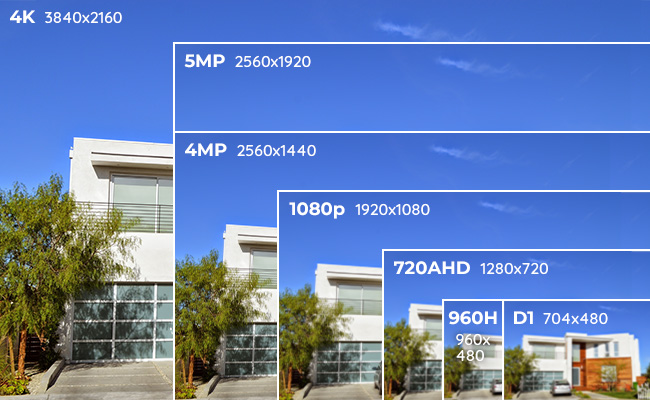
At 2MP, you get a clear overview but lose detail when you digitally zoom. At 4MP, you can crop into the frame and still identify people and objects. At 8MP, even distant subjects retain enough pixels for license plate capture and facial recognition.
When to Choose Each Resolution
2MP (1080p), Best for small rooms, doorways, and hallways where subjects are close to the camera. Ideal when budget is tight and you need reliable coverage without forensic-level detail. Works well for general awareness and deterrence.
4MP (1440p), The sweet spot for most residential and small business installs. You get noticeably better detail than 2MP without the storage and bandwidth demands of 4K. Good for front doors, backyards, and retail spaces where you need to identify people but not read plates at distance.
8MP (4K), Best for parking lots, long driveways, loading docks, and any area where subjects are far from the camera. The extra pixels let you digitally zoom after an event and still extract usable evidence. Expect higher storage costs and stronger network requirements.
AI Detection vs Motion Detection
Resolution is only half the story. How your system decides when to alert you matters just as much as how clearly it records.
Motion detection watches for pixel changes in the frame. When something moves, a person, a tree branch, a shadow, a car headlight, or an insect, the system triggers an alert. Motion detection is inexpensive, works on virtually any camera, and requires no special hardware. The downside: false alarms. Outdoor cameras with motion-only detection can send dozens of notifications per day from wind, weather, and lighting changes. Many users end up disabling alerts entirely.
AI / smart detection uses on-camera or NVR-based analytics to classify what moved. Instead of "something changed," you get "person detected," "vehicle detected," or "package detected." This dramatically reduces false alerts and makes mobile notifications actually useful. AI-powered systems also enable smart search, filter hours of footage by person, vehicle, or clothing color in seconds instead of scrubbing through video manually.
When motion detection is enough: Fixed indoor areas with stable lighting, such as a stock room or interior hallway, where movement almost always means a person. Budget installs where alerts are nice-to-have rather than critical.
When AI is worth it: Outdoor cameras exposed to weather and wildlife. Busy scenes with traffic, pedestrians, and moving shadows. Any install where you rely on phone notifications to respond in real time. AI features typically require IP cameras and a compatible NVR or VMS, they are not available on basic analog-only setups.
Putting It Together
A well-designed system mixes resolutions based on each camera's job: 2MP for tight indoor spaces, 4MP for general coverage, and 8MP where distance and detail matter most. Pair the right resolution with smart detection outdoors and motion detection indoors, and you get reliable alerts without alert fatigue.
TRC Integrated designs and installs camera systems for Long Island homes and businesses. We'll help you choose the right resolution and detection features for every location. Contact us for a free site assessment.